
- English
- Español
- Português
- русский
- Français
- 日本語
- Deutsch
- tiếng Việt
- Italiano
- Nederlands
- ภาษาไทย
- Polski
- 한국어
- Svenska
- magyar
- Malay
- বাংলা ভাষার
- Dansk
- Suomi
- हिन्दी
- Pilipino
- Türkçe
- Gaeilge
- العربية
- Indonesia
- Norsk
- تمل
- český
- ελληνικά
- український
- Javanese
- فارسی
- தமிழ்
- తెలుగు
- नेपाली
- Burmese
- български
- ລາວ
- Latine
- Қазақша
- Euskal
- Azərbaycan
- Slovenský jazyk
- Македонски
- Lietuvos
- Eesti Keel
- Română
- Slovenski
- मराठी
- Srpski језик

Load & Label 2 in 1 Robot Nesting Cell | Minimal Footprint, Phased Automation for Small Medium Factories
2 in 1 Load & Label Robot Nesting Cell | Compact Phased Automation | EXCITECH
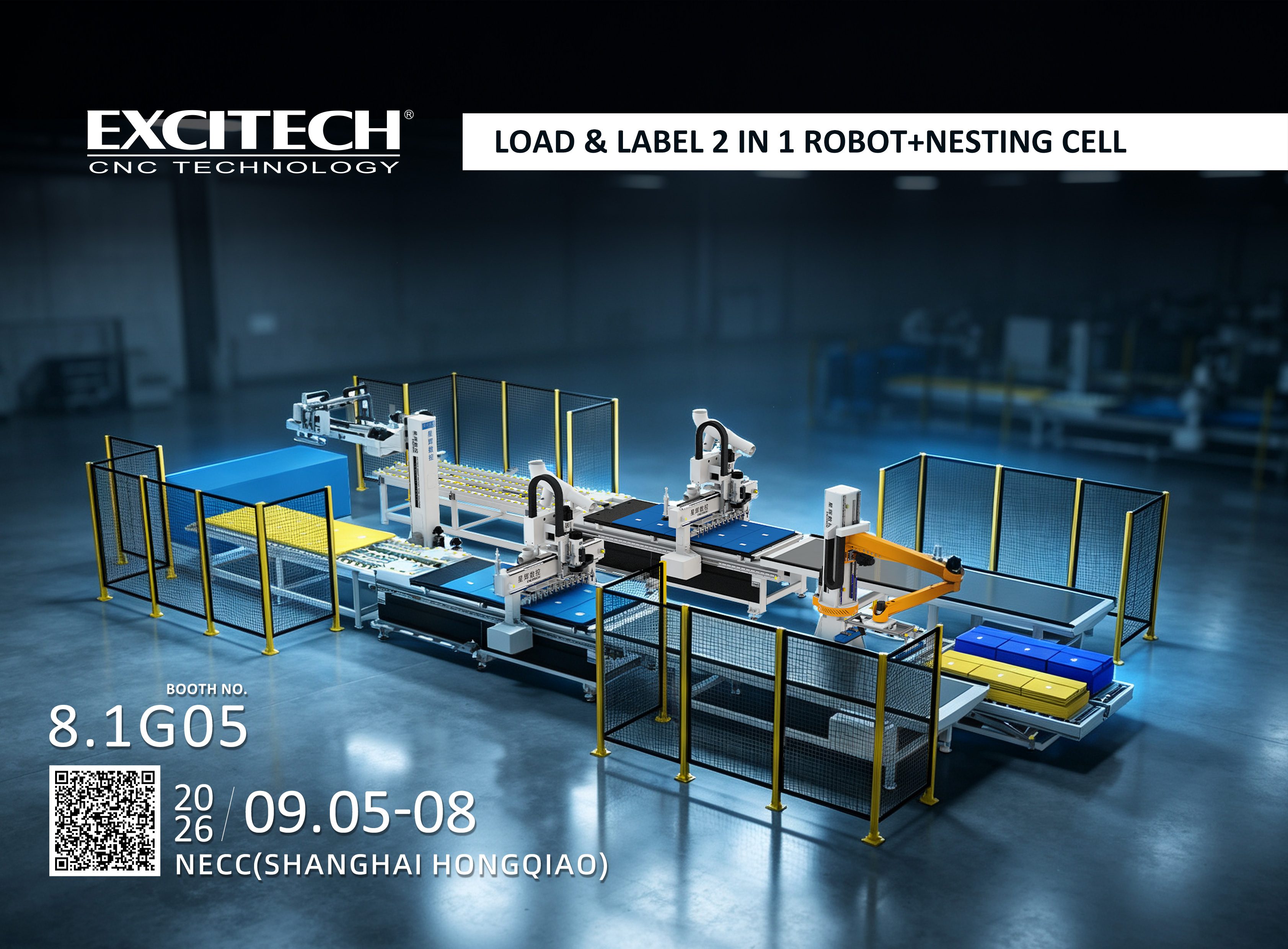
EXCITECH 2 in 1 robot nesting cell integrates loading, rotary labeling and dust free cutting. 13.8×6.3m footprint, no workshop renovation required, for factories looking to avoid high risk full unmanned line investment.
Product Overview
Many small to medium custom furniture factories hold back from implementing full unmanned production lines, and for valid reasons. Complete plant wide automation calls for large upfront capital, site modifications, extensive operator training, and fixed layouts that struggle with flexible small batch orders. When order mix shifts, large automated lines can sit underutilized and create financial risk for business owners.
To address this real world production challenge, EXCITECH developed the Load & Label 2 in 1 Robot + Nesting Cell. This entry level automated cutting workstation is built for existing workshop retrofits and facilities with limited floor space. Guided by the principle: MAXIMUM PRODUCTIVITY. MINIMAL FOOTPRINT, the all in one unit eliminates bulky separate station layouts. Loading, rotary labeling, dust free nesting cutting and part off load fit within a 13.8 m × 6.3 m footprint. It enables factories to take incremental, low risk automation steps without committing to full plant automation all at once.
Core Advantages & Technical Strengths
1. Ultra Compact Integrated Layout, No Workshop Renovation Required
Unlike conventional automated cells that demand substantial floor area and site rework, this EXCITECH nesting cell consolidates feeding, labeling, cutting and off load into one self contained workstation. At only 13.8×6.3m, it fits well inside older workshops and smaller production facilities. Upgrades can happen on your existing shop floor, removing renovation expense, production downtime and layout change risks for practical automation adoption.
2. Combined Robot Loading & Rotary Labeling, Remove Secondary Panel Handling
One robotic system handles panel picking, automatic feeding and precision rotary labeling. Workflow sequence: robot picks panels from material rack → applies consistent rotary barcode labels during transit → feeds panels directly to the nesting machine. Separate standalone labeling stations and manual rehandling are eliminated.
The rotary labeling mechanism delivers repeatable label placement on every panel. Unique barcodes create full traceability for each workpiece. Data can connect downstream to edgebanding, six sided drilling and automatic sorting to support digital production workflows.
3. Parallel Non Stop Processing to Lower Labor Demand
Moving past the stop start operation of standalone machines, the cell runs parallel tasks: while the nesting machine cuts panels, the robot prepares and labels the next set of raw boards. This reduces machine idle time and supports continuous cycles.
Automated loading and labeling replace manual work at these stations. On site experience shows one robot setup can cover the work previously done by two operators. It eases hiring pressure, lowers labour cost and removes quality variation caused by manual handling, raising per shift output.
4. Full Dust Free Cutting Design for High Grade Panel Surfaces
High gloss, PET and melamine panels commonly suffer surface scratches and dust residue in custom cabinet shops. This nesting cell uses fully enclosed dust control hardware: enclosed cutting zone, overhead brush cover and central vacuum extraction to contain cutting debris. Less airborne dust means fewer panel surface marks, less post cut cleaning work and higher yield for premium cabinet parts.
5. Modular Expandable Hardware for Phased, Low Risk Growth
Standard reserved connection interfaces replace closed, non expandable automation hardware. Factories can start with the core load label cut unit to achieve basic automation and labour savings. As order volumes grow, users may add robotic unloading / palletizing or connect edgebanders, six sided drill machines and conveyor systems step by step.
This supports phased capital spending: prove automation benefits first, then scale capacity. It avoids the large gamble of a one shot full line unmanned rebuild.
Phased Automation vs Full Unmanned Lines
For most small and medium cabinet manufacturers, full plant unmanned automation is not a universal fix, and carries notable risks:
• Heavy capital outlay: full line systems require large investment with long payback periods
• Strict site constraints: often demands large bays plus civil works modification
• Limited order flexibility: rigid full line setups struggle with high mix small batch custom work
• High downside risk: lines may become underutilized if production volumes change
The EXCITECH 2 in 1 nesting cell mitigates these concerns. With modest investment and compact footprint, it automates the most labour heavy, error prone loading and labeling steps. Production quality stabilizes, labour cost goes down, and part level traceability is established. Meanwhile expansion interfaces remain available for future full line upgrades. It delivers a practical, lower risk automation path for traditional cabinet factories.
Application Scenarios
Well suited for new plants with limited space, existing workshop retrofits, high mix small batch whole house cabinet production, and operators who want to test automation before committing to large scale capacity expansion.
Get Customized Solution
Reach out to EXCITECH technical team for custom workshop layout proposal and phased automation upgrade plan. Move forward with your low risk smart manufacturing transformation.